
Quick Answer
A Persian carpet shop near you should offer genuine hand-knotted rugs with clear authenticity documentation, not just imported machine-made imitations labelled loosely as “Persian style.” Gym flooring, by contrast, is a purely functional category — rubber tiles and mats are the standard choice for home and commercial gyms in Abu Dhabi due to their shock absorption and durability under heavy equipment. Laminate flooring remains a popular middle-ground choice for general living spaces, balancing cost, appearance, and durability. Persian carpets range from AED 2,000–50,000+, gym flooring runs AED 35–120 per sq. ft, and laminate flooring costs AED 25–90 per sq. ft installed. Risala Furniture and Interiors LLC supplies all three categories across Abu Dhabi.
Key Facts Table
| Category | Price Range | Key Consideration | Typical Lifespan |
| Persian carpet | AED 2,000–50,000+ | Hand-knotted authenticity, knot density | 50–100+ years (with care) |
| Gym flooring | AED 35–120 per sq. ft | Shock absorption, weight capacity | 10–15 years |
| Laminate flooring | AED 25–90 per sq. ft | AC rating (durability class) | 10–20 years |
Introduction
This guide brings together three distinct but commonly searched flooring and furnishing categories in Abu Dhabi: finding a reliable persian carpet shop near me, selecting appropriate gym flooring abu dhabi for home or commercial fitness spaces, and choosing the right laminate flooring abu dhabi grade for general living areas. Each involves different priorities — cultural and material authenticity for carpets, functional performance for gym flooring, and cost-effective durability for laminate.
What to Look for in a Persian Carpet Shop
Not every shop selling “Persian carpets” is offering genuinely hand-knotted, Iran-woven pieces. A reputable Persian carpet shop should be able to demonstrate:
- Knot construction visible on the reverse side — hand-knotted rugs show a clear, detailed mirror pattern on the back
- Material transparency — clear labelling of wool, silk, or wool-silk blend composition
- Regional origin information — reputable sellers can explain the weaving tradition or region associated with a specific design
- Fair pricing relative to knot density and size — extremely low prices for large, intricately patterned rugs are often a red flag for machine-made or mislabelled pieces
Authenticity Checklist
| Check | What to Look For |
| Back of rug | Clear, detailed pattern matching the front |
| Fringe | Extension of foundation threads, not sewn on |
| Colour variation | Subtle natural variation (hand-dyed pieces) |
| Knot count | Stated or estimable; higher counts indicate finer detail |
| Documentation | Provenance or material composition information available |
Gym Flooring: Function Over Form
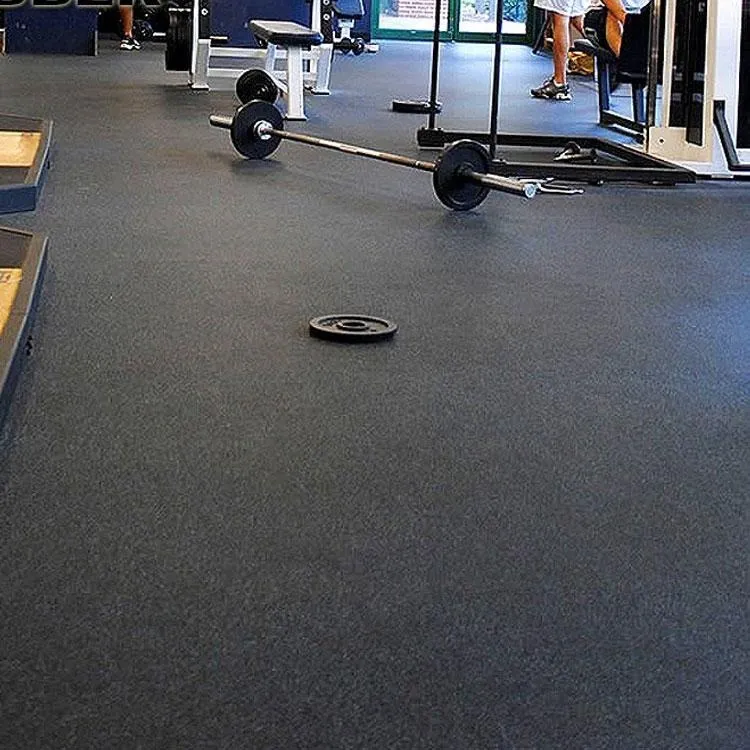
Gym flooring in Abu Dhabi — whether for a home gym or a commercial fitness facility — needs to prioritise safety and equipment protection over aesthetics. Common flooring types include:
- Rubber tiles — interlocking, shock-absorbing, ideal for free weights and high-impact zones
- Rubber rolls — continuous coverage for larger areas, reducing seams
- Foam mats — lighter-duty, suited to stretching or yoga zones rather than heavy equipment areas
- Vinyl sports flooring — used in studio or cardio zones where a smoother surface is preferred
Comparison Table: Gym Flooring Options
| Flooring Type | Shock Absorption | Best For | Approx. Cost/sq. ft |
| Rubber tiles | Excellent | Free weights, heavy equipment | AED 45–120 |
| Rubber rolls | Very Good | Full-room continuous coverage | AED 40–100 |
| Foam mats | Moderate | Stretching, light exercise zones | AED 35–70 |
| Vinyl sports flooring | Moderate | Cardio, studio/dance areas | AED 50–110 |
What to Consider Before Installing Gym Flooring
- Weight capacity — heavier equipment and dropped free weights require thicker rubber flooring (typically 15mm or more)
- Subfloor condition — uneven or damaged subfloors should be addressed before installation
- Odour and off-gassing — lower-quality rubber can carry a strong odour initially; higher-grade rubber tends to off-gas less
- Drainage or ventilation — relevant for gyms with heavy sweat exposure or limited air circulation
Laminate Flooring for General Living Spaces
While gym areas need specialised flooring, the rest of the home typically benefits from laminate flooring’s balance of cost, appearance, and low maintenance. As covered in durability terms, laminate is graded by AC (Abrasion Class) rating:
- AC3 — suitable for bedrooms and lower-traffic rooms
- AC4 — suitable for living rooms, hallways, and general residential use
- AC5 — suitable for high-traffic residential or light commercial areas
Laminate flooring is not recommended for gym spaces with heavy equipment, since it lacks the shock absorption and impact resistance that rubber flooring provides.
Step-by-Step: Setting Up a Home Gym Floor
- Assess the room’s subfloor for levelness and any moisture issues.
- Choose flooring thickness based on equipment type — thicker rubber for heavy free weights, thinner for cardio-only spaces.
- Measure precisely to minimise seams, which can become tripping hazards over time.
- Install interlocking tiles or rolled rubber, ensuring edges are properly secured.
- Inspect regularly for shifting or wear, particularly in high-impact zones.
Actionable Tips
- When shopping for a Persian carpet, always ask to see the back of the rug before discussing price — this single step filters out most machine-made imitations quickly.
- For home gyms with free weights, choose rubber flooring at least 15mm thick to adequately absorb impact and protect the subfloor.
- Don’t install laminate flooring in a dedicated weights area — it will scratch, dent, and crack under repeated impact.
- Ask gym flooring suppliers about odour levels before installation, particularly for enclosed spaces with limited ventilation.
Frequently Asked Questions
1. How do I find a trustworthy Persian carpet shop near me? Look for shops that can show the knot construction on the back of the rug, provide material composition details, and offer transparent pricing relative to size and knot density.
2. What is the best flooring for a home gym? Interlocking rubber tiles or rolled rubber flooring are generally best for home gyms, offering shock absorption and durability under heavy equipment.
3. How thick should gym flooring be for free weights? A minimum of 15mm is commonly recommended for areas where free weights will be dropped, with thicker options available for heavier equipment.
4. Can laminate flooring be used in a gym? It’s not recommended for weight-training areas due to limited shock absorption, though it may be acceptable in light-use spaces like a home yoga or stretching corner.
5. How much does a genuine Persian carpet cost? Prices range from around AED 2,000 for smaller or less intricate pieces to AED 50,000 or more for large, finely knotted, high-quality carpets.
6. What AC rating should I choose for laminate flooring in a living room? AC4 is generally recommended for living rooms and hallways due to moderate-to-high foot traffic, while AC3 suits lower-traffic bedrooms.
7. Does rubber gym flooring have a strong smell when first installed? Some rubber flooring, particularly lower-grade products, can have a noticeable odour initially, which typically fades over time; higher-grade rubber tends to have less off-gassing.
8. Is it worth buying an antique Persian carpet, or should I choose a new one? Both can be valuable — antique pieces often carry higher resale and heirloom value, while new hand-knotted carpets offer the same craftsmanship with more colour and pattern flexibility.
9. Can gym flooring be installed over existing tile or laminate? In most cases, yes, provided the existing surface is clean, level, and structurally sound.
10. Where does Risala Furniture and Interiors provide its services? Risala Furniture and Interiors LLC provides its services in UAE ,OMAN , QATAR , SAUDI ARABIA , KUWAIT , BAHRAIN and all across the Gulf and Middle East region.
Key Takeaways
- Genuine Persian carpets are verifiable through back-pattern inspection and material transparency from the seller.
- Gym flooring should be selected based on equipment weight and impact level, with rubber generally outperforming other materials.
- Laminate flooring remains the practical choice for general living spaces but is unsuitable for heavy-equipment gym areas.
- Matching flooring type to room function prevents premature wear and costly replacement.
Conclusion
Persian carpets, gym flooring, and laminate flooring serve very different purposes, but each benefits from the same underlying principle: matching material choice to actual use. A carpet bought for its craftsmanship deserves proper authenticity verification, a gym floor needs to handle real impact loads safely, and everyday living spaces benefit from laminate’s practical balance of durability and cost. Risala Furniture and Interiors LLC advises Abu Dhabi homeowners to treat each of these as a distinct decision rather than a one-size-fits-all flooring choice.
📍 Visit us: maps.app.goo.gl/igmNHkW1QCyL19wT7?g_st=ac
